
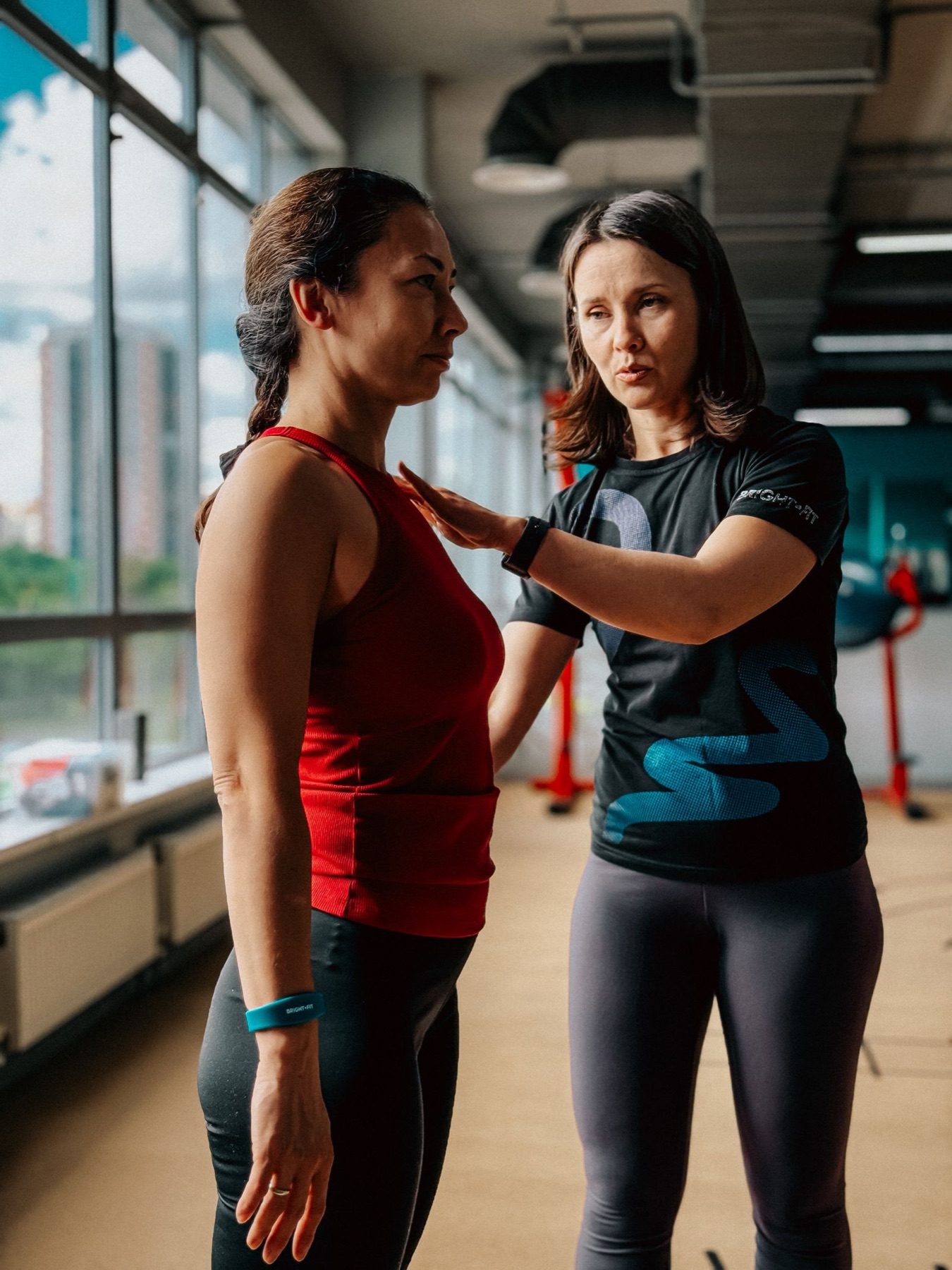
Ask a trainer how they will measure your progress, and listen for the watch.
A new study found four popular smartwatches missed calories burned by a median of roughly 15% to 25%, and the miss grew with body fat. Here is why that matters when a trainer tells you how they will track your progress, and what a better answer sounds like.
Before you pay a trainer anything, ask one question: how will we know this is working? If the answer rests on the calories-burned number from your smartwatch, pause there. A study reported in September 2026 found four popular watches off by a median of roughly 15% to 25% during exercise, and for people with higher body fat some of them missed by 50% to 100% or more. In that study, the number was least accurate for the participants with higher body fat.
What should a trainer say when you ask how they will measure your progress?
A good trainer answers the progress question with things you actually did: how much you lifted, for how many reps, how far and how fast you walked, how hard it felt, and how your clothes fit. Those are records of your own body doing real work, and both of you can see them move.
A weaker answer points at a single figure produced somewhere else, usually the calories-burned number on a watch. A trainer who glances at it is not doing anything wrong. The warning sign is a program whose decisions hang on it, where a week counts as good or bad depending on what the watch said you burned.
Ask the question at O-SEA Fit before you commit to anything, and ask it everywhere else you are considering too. Listen for specifics. A trainer who can tell you what they will write down after each session, and what would make them change the plan, has thought about it. A trainer who says the watch's calorie figure is unreliable for you is naming the edge of a tool, and somebody comfortable doing that is usually careful inside it.
How accurate is a smartwatch calorie count during exercise?
Smartwatch calorie counts during exercise are estimates, and a new study measured how far off they run. Researchers at Florida International University, writing in The Conversation in September 2026 about their PLOS ONE paper, tested 58 adults on a recumbent bike wearing an Apple Watch Series 8, a Garmin Forerunner 955, a Samsung Galaxy Watch5 and a Fitbit Sense 2, and compared each against a metabolic analyzer, the lab equipment that measures energy use from the air you breathe.
All four watches showed substantial error, with median errors of roughly 15% to 25%. Apple, Garmin and Samsung consistently overestimated calories burned. For those three the error leaned one direction, so it would not be expected to cancel out over a week of workouts. Fitbit's average error was not systematically high or low, but it produced several implausible readings.
The study has limits. The participants were Hispanic adults, and results in other groups may differ. It is one study. The larger limit for anyone choosing a trainer is the recumbent bike: a training session is mostly lifting, carrying, circuits and intervals, and this study tells us nothing directly about any of them. Whether smartwatch calorie error is smaller, larger or shaped differently during strength or circuit work is unknown from this evidence. A plan that treats the watch as reliable in the weight room is assuming an accuracy nobody here measured.
Smartwatch calorie error grows with body fat, which is where it can matter most
Smartwatch calorie error climbed with body fat in the Florida International University study. For participants with higher body fat percentages, some watches missed by about 50% to 100% or more. The author gave a worked example: someone with 35% body fat or more, exercising four hours a week, could see a watch be 1,200 to 2,400 calories off per week.
People who start training to change their body composition may be watching the calorie figure closely. At higher body fat, the study suggests, that is when the figure is least reliable. A figure off by a fifth is a nuisance. A figure that may be off by double is not something to build a plan on.
None of this says anything about anyone's body or discipline. It is a limit of the device, and a trainer steering by it for you is steering with a loose wheel that neither of you can feel.
The best case for the calorie number is nutrition, and that is where the error costs the most
The strongest reason a trainer uses the smartwatch calorie number is not the workout. It is food. Setting a calorie deficit means estimating what goes out as well as what goes in, and the watch is the easiest source for the first half. Some plans go one step further and tell you to eat back what the watch says you burned.
That step is where the Florida International University numbers start to matter. If a watch overstates the burn by 1,200 to 2,400 calories a week, as the author's example showed is possible, and you eat those calories back, the error can be large enough to wipe out a deficit. You did the training and followed the plan, the scale did not move, and the natural conclusion is that you failed. The plan failed, and it failed quietly, because nothing in it could show the error.
A trainer who handles nutrition well either leaves exercise calories out of the eating target or treats them as a rough reference, and then adjusts the plan from what actually happens over several weeks rather than from what the watch reported that evening.
This approach does not suit everyone. If you have a medical reason to manage intake or output precisely, that belongs with your doctor or a registered dietitian, not a trainer and not a watch, and a trainer should say so plainly.
Is a smartwatch calorie estimate still useful if it is consistently wrong?
The best argument for the smartwatch calorie number as a progress tool is that consistency matters more than accuracy. If a watch always overestimates by about the same amount, rising or falling numbers still show a trend, and a trend is what a trainer needs.
The Florida International University study weakens that argument without settling it. The error was not a fixed offset across people: it was larger in people with more body fat. The study compared different people at one point in time and did not follow anyone as their body fat changed, so whether one person's error drifts as they lean out is an inference, not a finding. If the pattern holds within a person, the error moves with the very thing many people are training to change. A ruler that stretches as you grow is hard to read a trend from.
Even a perfectly accurate calories-burned figure would say little about progress. It does not show whether you got stronger, moved better or recovered faster. The study's own author notes these devices remain useful for duration, distance and pace. The calorie figure is the part to hold loosely.
What should you ask a personal trainer about tracking before you pay?
Ask a personal trainer four tracking questions before you pay: what they will measure in the first session, how often they will measure it again, what result would make them change the program, and which of your own numbers they will not use. All four questions about a trainer's tracking can be asked in a first conversation, before any money changes hands.
A good answer sounds concrete. It names things you can picture, such as a starting weight for a lift, how many reps you did and how hard they felt, and a date roughly a month out to repeat them. It says what they cannot know yet. It declines to promise a result by a specific date, because an honest trainer does not know how your body will respond before they have watched it respond.
A weaker answer leans on a confident number with nothing behind it: a daily calorie burn target taken straight from your watch, or a promised outcome by a particular week. Be suspicious of a confident number. The more exact it sounds, the more it is worth asking where it came from.
A useful training log records what you did, measured directly, not estimated
A useful training log is made of measurements taken directly: the load, the reps, the pace over a fixed route, the rest needed between efforts, and an effort rating on a 0 to 10 scale like the one the CDC describes. None of these is estimated by a device from indirect signals. They can still be written down wrong, and a heavier bar is not automatically progress, which is why effort sits in the log beside the load.
Here is what a decision from a log looks like. In week one, a client squats a load for eight reps and rates it 8 out of 10. Three weeks later, same load, ten reps, rated 6. That record supports adding weight. If the reps had climbed while effort also climbed to 9, the same log says hold the load and look at sleep and recovery first. No calorie figure appears in either decision, and none would improve it.
Clothes fitting differently, and for some people a tape measure at the waist, belong in the log too. The scale can sit beside them as one measure among several, never the only one on the chart.
This approach does not suit someone who needs a fresh number every evening to stay motivated. Strength and pace move over weeks, and a log will look flat on plenty of days when a watch would have offered congratulations.
A figure off by a fifth is a nuisance. A figure that may be off by double is not something to build a plan on.
At the first meeting, ask the trainer to describe one decision they would make from your log in the first month, and what would have to be written there for them to make it. An answer built from loads, reps, pace and effort is one you can check yourself. An answer that declines to promise a result by a date is usually the one worth paying for.
Further reading
- Jason Kostrna, Florida International University, in The Conversation: write-up of the PLOS ONE study testing four smartwatches against a metabolic analyzer theconversation.com/the-higher-your-body-fat-percentage
- Centers for Disease Control and Prevention: how to measure physical activity intensity, including the 0 to 10 effort scale and the talk test cdc.gov/physical-activity-basics/measuring
Every source above was fetched and a verbatim phrase confirmed on the page before this essay published. Nothing here is paraphrased from memory.