
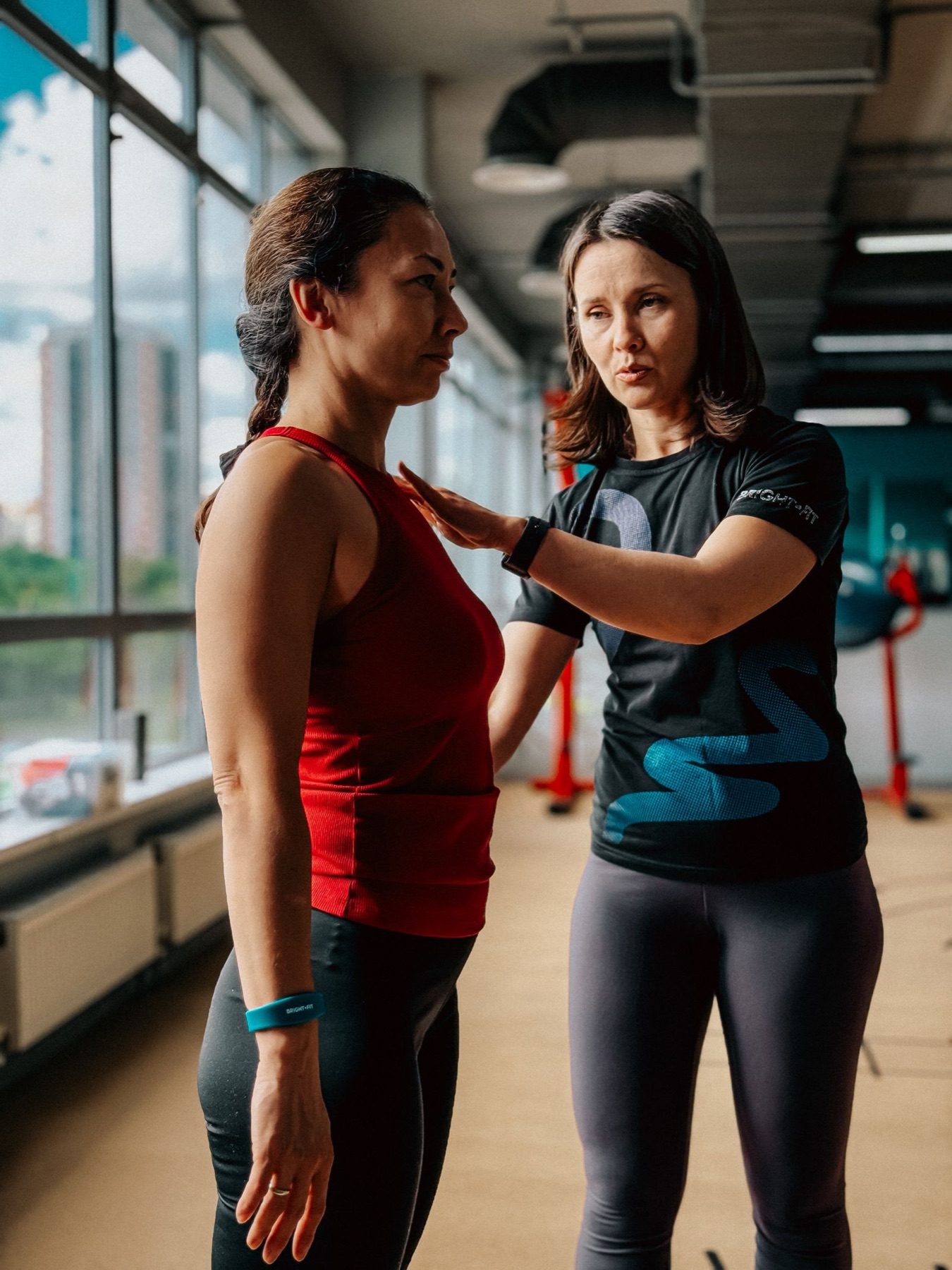
Group class or one to one: how to tell which you need
Neither is better. They solve different problems, and picking the wrong one is the most common reason people quit within two months.
This question gets answered by price far more often than by fit, which is why so many people end up in the wrong one and conclude that training is not for them.
One to one suits you if
- You have a specific goal with a specific reason behind it.
- You are working around an injury, a restriction or a long gap.
- You would rather not learn new movements in front of a room.
- Your schedule is irregular and a fixed class timetable will not survive it.
A group class suits you if
- You will train more often if other people are expecting you.
- You want the session decided for you.
- You like the social half as much as the training half.
- You want the cost per session to be lower and are comfortable being coached in a group.
The honest trade
One to one buys attention. A group buys momentum. Most people who succeed long term end up with some of both, and the sequence usually matters: a few one-to-one sessions to learn the patterns, then a class habit that keeps you coming, with occasional one-to-one when something needs fixing.
The question that decides it
Ask yourself which is more likely: that you will skip a session nobody notices, or that you will avoid a room where people might watch you. Whichever answer is more true is the one to pick against.
Where this does not apply
If the obstacle is time rather than format, neither answer helps. Two honest sessions a week that survive a bad month beat four that only happen in a good one, and a trainer who tells you that before taking your money is the one worth having.
If the group option appeals, O-SEA CrossFit is the same owner and the same building, and its own guide on <a href="https://oseacrossfit.com/guides/what-your-first-crossfit-class-is-actually-like/">what a first class is actually like</a> is a fairer description than anything we could write about it here.
What each one costs you beyond money
A class costs you specificity. The session was written for the room, so on any given day some of it will not be the thing you most needed. Over months that averages out well; over a six-week run at one goal it does not.
One to one costs you the room. No one is expecting you on Tuesday except the person you are paying, and for a lot of people that turns out to be a weaker commitment than a handful of people noticing an absence.
A test that takes one week
Book one of each, a few days apart, before committing to either. Then ask which one you were quietly looking forward to and which one you found reasons to move. That answer is more reliable than any amount of thinking about it, and both are usually available as a single session rather than a block.
Common questions
Is one to one better than a class?
No. They solve different problems. Attention versus momentum, and most people eventually want some of each.
Can I do both?
Yes, and it is a common pattern: learn the movements one to one, then keep the habit in classes.
Which is cheaper?
A group class, per session. Whether it is better value depends entirely on whether you turn up.
Come and see for yourself
A conversation costs nothing and answers more than any page.